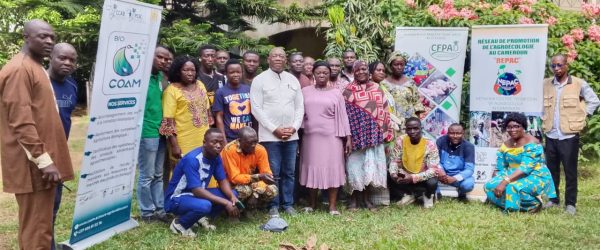
In Souza, organic farmers and experts in organic agriculture are building their capacity regarding compliance with specifications, as well as COAM’s certification mechanisms and procedures

WhatsApp Image 2026-11-25 at 18.27.51

Partager cet article

Share on facebook
Share on linkedin
Share on twitter
Share on email

Thirty-five (35) producers joined the Cameroon Organic Agriculture Movement (COAM) following the training workshops held on November 20 and 21 at the DUCA de Souza Agropastoral Vocational Training Center. These sessions aim to strengthen the skills of stakeholders in the organic sector within the bimodal forest agroecological zone.

Promoting organic agriculture also requires a better understanding of standards and certification mechanisms. With this in mind, the DUCA de Souza Agropastoral Vocational Training Center hosted two training sessions on November 20 and 21 dedicated to the certification program of the Cameroon Organic Agriculture Movement (COAM).

The first session, intended for organic producers, focused on compliance with specifications, inspection mechanisms, and certification procedures. A total of 35 producers who participated in this training program joined COAM. This move reflects their commitment to becoming part of an organized organic production system based on compliance with standards and transparency in practices.

The participants’ satisfaction was evident. “I’m very satisfied with the quality of the training. Now I’m ready to talk about organic farming,” said one of the participating producers. This comment illustrates the value of this initiative in helping participants better understand the principles and requirements of organic farming.

On November 21, a second session brought together local liaisons and COAM experts to discuss the conduct of audits and inspections of organic operators. Several member organizations of the Network for the Promotion of Agroecology in Cameroon (REPAC) took part in the session. The goal was to strengthen their technical skills in order to ensure better monitoring of producers and rigorous enforcement of the program’s requirements.

The workshop was led by Jean Marie MBARGA, COAM coordinator, who provided educational guidance to the participants. The discussions helped deepen participants’ understanding of the movement’s four sets of specifications, as well as how COAM operates, its requirements, and the responsibilities of the various stakeholders involved in the certification process.

At the local offices, the training was also viewed as an important step in preparing for field assignments. “We’re going to do our job,” said one of the participants, expressing his determination to put the knowledge gained during the audits and inspections into practice.

Beyond strengthening individual skills, these workshops help to structure the organic farming movement in the bimodal forest zone. They should also promote more effective support for operators and strengthen the credibility of COAM’s control and certification mechanisms.
Continuez votre lecture...

ABCD2 project

Projet ABCD-Un élève un arbre COP28

1. Project title

Supporting the scaling-up of community experiences and citizen monitoring of public policies in response to climate change in sub-Saharan Africa (ABCD 2 project)

2. Summary

The project to scale up community experiences and dynamics of citizen monitoring of public policies in the face of climate change in sub-Saharan Africa is the continuation of an initial project to capitalize on these experiences.

In fact, in 2022, with funding from the Basque Agency for Development Cooperation (ABCD), Inades-Formation carried out the “Study-capitalization of good practices in the face of the challenges of climate change and local governance in sub-Saharan Africa ” project, which capitalized on 50 experiences, including 31 climate change adaptation experiences and 19 governance experiences in 11 sub-Saharan African countries.

Based on the results of this pilot project, we have been able to identify and capitalize on some of the living realities of community efforts to combat the problems posed by climate change in Africa. They have been developed by a variety of players, including public services specializing in environmental and climate change management, civil society organizations and farmers’ organizations.

This second phase of the project, which will run for 30 months (2022-2024), aims to (i) scale up these good experiences developed by communities in African countries, in terms of adaptation, mitigation and resilience to climate change and of (ii) support the dynamics of citizen monitoring of the associated policy and regulatory frameworks.

ACF-AO project

WhatsApp Image 2023-08-24 at 15.13.12

1. Project title

Feminist Climate Action Project – West Africa ACF-AO

2. Summary

The “Feminist Climate Action in West Africa” project is being implemented in Côte d’Ivoire to contribute effectively to the resilience and fight against the effects of climate change by ecologically sensitive coastal and island communities, with a particular focus on rural women and young people.

It will build the capacity of communities, particularly women and young people, to implement strategies to protect biodiversity and ecosystems, notably through the adoption of agroecological practices, energy diversification and advocacy. It will strengthen the participation of rural women and young people in local governance of biodiversity and climate action.

Funded by Global Affairs Canada | Affaires mondiales Canada, the ACF AO project is taking place in Côte d’Ivoire, Guinea-Bissau, Senegal and Togo.

It is managed in Côte d’Ivoire by SUCO and Inades-Formation – Secrétariat Général.

FONDAFRICA LOGO

FondAfrica

Inades-Formation
Serving the Common Good

FondAfrica

Inades-Formation thanks you for your support for its actions of economic and social development in favor of the rural world.

Your donation will be forwarded to the recipient you have chosen.

Follow us by subscribing to our newsletters.

Inades-Formation
Serving the Common Good

FondAfrica

1. What is it?

The African Rural Development Fund (ARDF) was established on July 23, 1997 in Dar-es-Salaam, Tanzania, following the realization that Africa’s development can only be achieved through self-financing.

FondAfrica is an appeal to public generosity through collection actions from natural and legal persons.

2. Why make a donation?

FondAfrica is a particular instrument of Inades-Formation’s financing strategy. FondAfrica a formulé sa vision à moyen terme ainsi qu’il suit « In 10 years, thanks to the income from the funds collected by Fondafrica, Inades-Formation will have increased its self-financing capacity for services rendered to the African rural world to 40 % ».

Do you want to support Inades-Formation in its economic and social development actions for the rural world? If so, then take action through FondAfrica by making a donation.