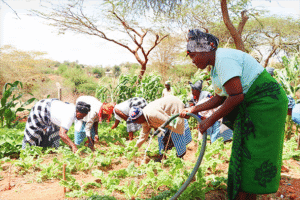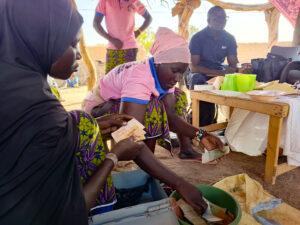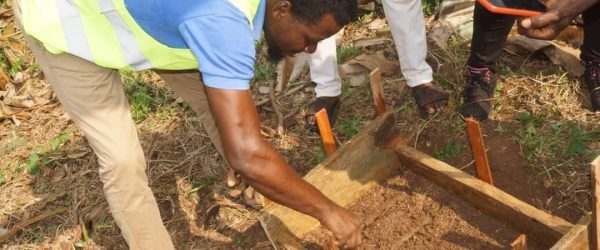
In the small town of Kamba, not far from Mfou, a new agricultural dynamic is taking shape. On January 30, 2026, producers and local residents gathered for a training session on organic chili pepper cultivation, given by NGAH Landry, a micro-intervention leader supervised by INADES-Formation Cameroun, as part of the Pôle de Connaissances pour l’Agriculture biologique et l’agroécologie en Afrique Centrale (PCAC) project.
The aim of this session was to equip growers with sustainable skills to improve their yields while preserving natural resources.
In Kamba, agriculture is the main source of livelihood. However, as in many rural areas, producers are faced with increasingly impoverished soils and the rising cost of chemical inputs. Faced with these challenges, organic farming is emerging as a credible alternative.
The choice of chillies is not an insignificant one. Highly consumed in Cameroonian households and in great demand on the markets, it represents a crop with great economic potential.
“Producing chillies organically not only protects the health of growers and consumers, but also adds value to production,” explains Ngah Landry. “We want to show that it’s possible to produce differently, with simple and accessible methods.”
The course was distinguished by its practical approach. On a plot set up for the occasion, participants discovered the essential stages of organic production: soil preparation using organic matter, seed selection, natural fertilization techniques and ecological pest control methods.
The focus was on restoring soil fertility and preserving biodiversity, two pillars of agroecology.
“Before this training, we thought that good harvests necessarily depended on chemicals. Today, we understand that soil health is the basis of everything,” confides local grower Thérèse.
An economic opportunity for communities
Beyond its environmental benefits, organic chili could become a real economic development lever for Kamba. In a market where consumers are increasingly attentive to food quality, organic products are gradually gaining ground.
“If we apply these techniques properly, we’ll be able to produce better quality chillies and sell them at a better price…. It’s a chance to improve our income”, says Martin Essomba, a young farmer.
The proximity of Mfou and the city of Yaoundé also enhances marketing prospects, opening the way to new outlets for growers.
This training is part of a broader vision: that of an agriculture capable of withstanding climatic and economic shocks. By limiting dependence on chemical inputs and making the most of local resources, producers gain greater autonomy.
For INADES-Formation Cameroun, supporting this type of initiative means preparing rural areas for the challenges of tomorrow.
“Agroecology proposes a global approach that reconciles agricultural performance, environmental protection and community well-being… Each trained farmer becomes an agent of change,” emphasizes Ngah Landry.
An encouraging collective dynamic
As the discussions progressed, a spirit of solidarity grew among the participants. Many expressed their willingness to share the knowledge they had acquired with other farmers, in order to broaden the impact of the training. Some even envisaged the creation of demonstration plots to encourage the adoption of organic farming throughout the locality. “We want Kamba to become an example. If we work together, we can transform the way we produce, “ says one participant with conviction.
Micro-interventions as catalysts for local change
The replication of this training illustrates the strategic role of micro-interventions in the dissemination of agricultural innovation. By bringing training closer to producers, these actions encourage rapid appropriation of best practices.
The Pôle de Connaissances pour l’Agriculture Biologique et l’Agroécologie en Afrique (Knowledge Cluster for Organic Farming and Agroecology in Africa) project relies precisely on this approach to accelerate the transition to more sustainable food systems.
As the session drew to a close, everyone was already looking to the future. Between curiosity and enthusiasm, the growers seem aware that they are taking part in a silent but essential transformation. Organic chilli cultivation may be just the beginning, but it symbolizes a profound evolution, for it is an agriculture that chooses to work with nature rather than against it.
In this peaceful town on the outskirts of Mfou, one thing is becoming clear: organic farming is no longer a distant idea. In Kamba, it is now a growing reality: the promise of a healthier, more profitable and more sustainable agricultural future.
Click on the link below to access the data sheet for the production of a pepper nursery using natural bio-inputs.
DATA SHEET PRODUCTION OF A CHILLI PEPPER NURSERY USING NATURAL BIO-INPUTS
Marguerite MOMHA, Communication Officer INADES-Formation Cameroun