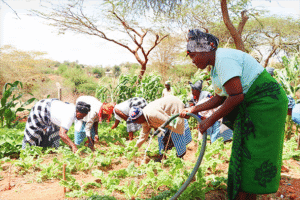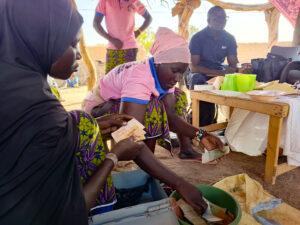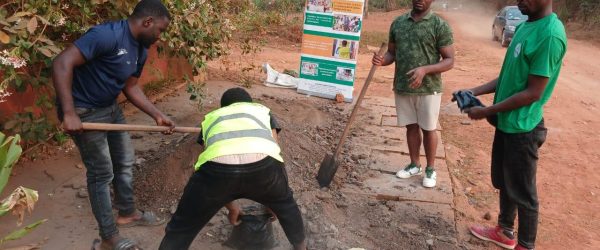
January 29, 2026 will remain a milestone for the people of Leboudi, a village in Cameroon’s Centre region. Here, farmers, young people and women experimented with an innovative agricultural method: organic permaculture bell pepper growing.
Set up in a training area, participants discovered how to transform simple plastic bottles and bags into agricultural containers capable of growing bell pepper plants. An approach that is accessible, economical and adapted to the realities of areas where arable land is in short supply.
This initiative at the crossroads of environmental and food issues is led by ESSOME Pierre Canis, a micro-intervention leader supervised by INADES-Formation Cameroun, as part of the Pôle de connaissances pour l’Agriculture Biologique et l’Agroécologie en Afrique (PCAC) project.
In Leboudi, the issue of plastic waste has become a matter of concern. At the same time, many households have little space for farming. Permaculture applied to recycled containers thus appears to be a concrete response to these challenges.
For the trainer, the objective goes beyond simple farming techniques: ” We want to show that it’s possible to produce healthily while protecting our environment. Plastic waste should no longer be seen only as a problem, but also as a resource. “explains ESSOME Pierre Canis.
The method consists of filling containers with an organic substrate enriched with compost, promoting optimal plant growth without the need for chemical fertilizers. This practice is fully in line with the principles of agroecology, which advocate sustainable production systems that respect ecosystems.
Learning to produce differently
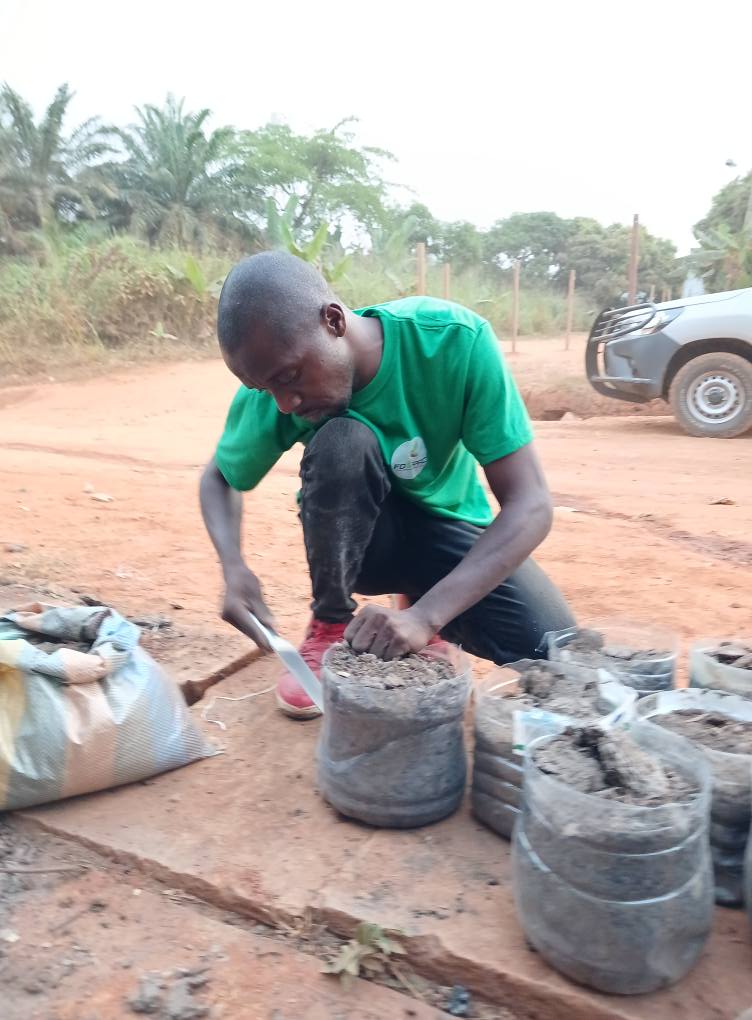
Throughout the session, participants alternated between theory and practice: preparing organic soil, transplanting seedlings, watering management and natural pest control techniques. The participatory approach enabled everyone to handle the potting soil and to project themselves into reproducing the technique at home.
“What we’re passing on today are simple solutions that communities can quickly get to grips with. Even with a small space behind the house, you can produce quality vegetables”, stresses the trainer.
For many local people, this training represents an opportunity to strengthen their food self-sufficiency while generating potential income.
Participants convinced by innovation
Visibly enthusiastic, participant OWONA Juliette is delighted with the discovery: ” I didn’t think it was possible to grow peppers in plastic bottles. It’s an ideal solution for us who don’t have large plots of land. I’m going to start at home this week. “
Armand BELIBI, a young farmer, is similarly motivated: ” This technique changes the way we look at waste. Instead of burning or throwing it away, we can use it to produce food. It’s good for our health and the environment. “
Beyond the ecological aspect, some participants see it as a response to the rising cost of agricultural inputs.
” With permaculture, we reduce our use of chemical fertilizers. This makes farming more accessible, especially for young people who want to start out on their own. “ says Claudine OWONO, a mother.
The initiative is part of a wider drive to promote organic farming in Cameroon. By focusing on resilient, low-cost techniques, INADES-Formation Cameroun aims to help communities move towards more sustainable food systems.
According to ESSOME trainer Pierre Canis, the potential impact is considerable: ” If every household adopts even a few containers, it can improve food safety while reducing plastic pollution. It’s a win-win situation. “
Growing peppers is no random choice. A widely consumed vegetable with a high market value, it offers interesting economic prospects for local producers.
Towards a change in farming practices
At the end of the course, one conviction seemed to be shared: tomorrow’s agriculture will have to be productive, ecological and adaptable to urban and rural constraints.
For Prospère AYINDA, a local notable, “This type of initiative shows that innovation isn’t just for big cities. Our villages can also be places of experimentation for modern, responsible agriculture.
By encouraging the reuse of waste and organic production, this micro-intervention also helps to raise awareness of the importance of preserving our living environment.
A seed of hope for agroecology
Leboudi’s experience illustrates the key role of local training in the agro-ecological transition. By bringing knowledge closer to the realities on the ground, they encourage the emergence of concrete solutions to food and environmental challenges. At the end of the session, several participants leave with their first seedlings, a symbol of their budding commitment. ” We don’t just want to consume, we want to produce healthily”, sums up one participant.
In Leboudi, organic permaculture bell pepper growing, nestled in containers once destined for abandonment, embodies much more than an agricultural technique; it represents a new way of thinking about production, where every waste product can become a resource and every space, however small, a place of nourishing life.
MARGUERITE MOMHA, Communication Officer INADES-Formation Cameroun