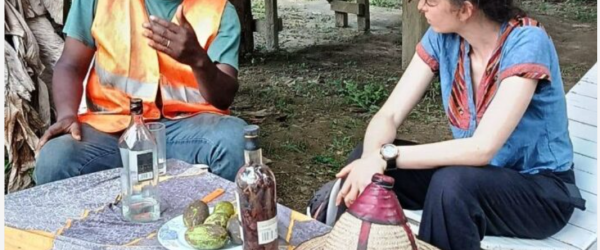
From agricultural production to fish farming, including livestock raising, training, and agro-ecotourism, François Cyriaque Evina is developing an entrepreneurial approach in Esse, in the Centre region, based on the synergies between activities, the utilization of local resources, and the reinvestment of revenues. This initiative raises questions about the paths to economic self-sufficiency for rural farms.
What if the viability of a rural business depended less on diversifying production and more on the ability to make those different operations work together? In Esse, François Cyriaque Evina has been putting this approach into practice for over thirty years. Through the FAPE (Ferme AgroPiscicole d’Esse), he is gradually building an economic ecosystem in which agriculture, fish farming, livestock raising, training, and agro-ecotourism are designed to reinforce one another. This approach places the development of local resources, income diversification, and the pursuit of financial autonomy at the heart of rural entrepreneurship.
From project management to grassroots entrepreneurship
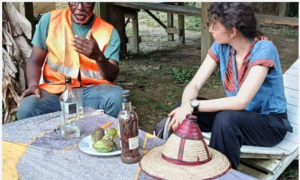
François Cyriaque Evina’s career began in the fields of accounting, management, and project leadership. For twenty-five years, he worked at several international organizations, including INADES-Formation, the FAO, the UNDP, CIFOR, and the Wildlife Conservation Society. This experience allowed him to become familiar with the mechanisms of planning, budgeting, financial control, and monitoring of development interventions. But as his career progressed, one question took on increasing importance: How can the continuity of economic activities be ensured when external funding dries up? He chose to provide a concrete answer to this question, right on the ground. By gradually investing his own resources in the family farm in Esse, he set out to transform a family legacy into a space for production, experimentation, and the transmission of know-how. FAPE thus became the place where, step by step, a new way of envisioning rural enterprise took shape: not as a juxtaposition of activities, but as an integrated whole organized around economic and ecological complementarities.
The EVINA Model: Creating Synergy Among Business Activities
The approach developed at FAPE is based on a core belief: a farm’s performance is not measured solely by the quantities it produces, but also by its ability to control costs, make the most of its resources, and diversify its revenue streams. With this in mind, agricultural, aquaculture, and livestock activities are designed to work in tandem. The goal is to make better use of available resources, limit losses, reduce dependence on outside purchases as much as possible, and create multiple sources of income. A portion of the revenue must then be reinvested to support the continuity and development of these activities. This approach forms the foundation of what can be described as the EVINA business model. It emphasizes gradual investment, learning through experience, and the pursuit of financial independence built over the long term. It also requires adaptability: testing, observing results, learning from challenges, and adjusting production and marketing decisions. The challenge is to move beyond a siloed view of farming. When well organized, multiple activities can help spread economic risks, diversify the product range, and make better use of local resources. However, the actual profitability of such a system remains dependent on cost control, work organization, market outlets, and market demand.
Agroecology as a Principle for Farm Organization
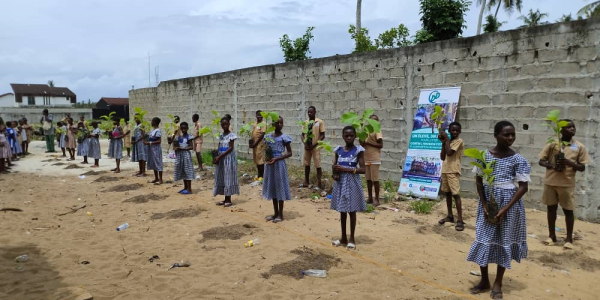
Beyond its economic dimension, the FAPE initiative is part of a broader discussion on the sustainable management of natural resources. In a forested environment like that of Esse, production systems face challenges related to soil fertility, land use, and the conservation of available resources. The approach championed by Cyriaque Evina seeks to align production organization with biological processes and the synergies between activities. The goal is to demonstrate that utilizing local resources and experimenting with adapted agroecological practices can contribute to production that is more in tune with the realities of the environment. This approach positions agroecology beyond the mere question of farming techniques. It invites us to rethink how a farm organizes its resources, minimizes losses, and coordinates its various functions. The circular economy thus becomes a key area of focus: making better use of what is available on-site, seeking opportunities for value creation, and avoiding, as much as possible, the loss of potentially useful resources. However, the scope of this experiment must also be assessed in light of documented results: production costs, volumes sold, changes in income, reduction in losses, and the effects of these practices on natural resources. These factors will provide a better measure of the model’s economic and environmental performance.
Train to pass on knowledge, adapt, and spread the word
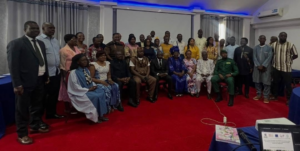
A farm can be a place of production. It can also become a space for learning and demonstration. It is in this second context that Form’Action fits in. developed at FAPE, based on hands-on learning and the sharing of experiences. The goal is to bridge the gap between theoretical knowledge and real-world realities and to enable participants to better understand the principles of organizing a diversified rural business. Beyond production techniques, the program opens up discussions on management, investment, cost control, identifying market opportunities, and reinvesting revenues. Support initiatives are also being considered to adapt certain principles of this approach to other regions, particularly Gabon. Such a prospect raises a central question: how can an experience be replicated without mechanically copying a model designed for a specific context? Available resources, skills, infrastructure, consumption patterns, and markets differ from one region to another. The transfer of knowledge must therefore be accompanied by adaptation to local conditions. The model’s value will also be measured by this capacity for local adaptation: not only by what it produces at the FAPE site, but also by what it enables other rural entrepreneurs to understand, experiment with, and build upon in turn.
“Chez Cyriaque”: Culture Supporting the Local Economy
FAPE’s diversification is set to take a new step forward with the announced opening of “CHEZ CYRIAQUE – Cabaret in the Forest”, scheduled for Saturday, October 31, 2026. Conceived as a new cultural and recreational space, the cabaret is intended to complement the farm’s economic ecosystem by creating a meeting place where visitors, culture, and production activities intersect. The idea is not to treat this new space as a standalone activity. Visits to the cabaret could encourage people to explore the farm and create additional market opportunities for its agricultural, aquaculture, and livestock products, as well as for its dining, lodging, and recreational services. This integration of culture and agriculture opens an interesting avenue for the rural economy: turning the experience of visiting a production site into a lever for marketing and income diversification. However, this ambition will have to contend with market realities. Visitor numbers, the quality of the hospitality, the consistency of the offerings, and the ability to convert visits into purchases or revenue-generating services will be key factors in assessing the cabaret’s actual contribution to the FAPE’s economy. The opening of “Chez Cyriaque” thus marks a new phase in the farm’s diversification strategy. After developing several production activities, the initiative aims to strengthen the links between these activities and the services likely to attract customers to the site.
An experiment that raises questions about the viability of rural businesses
In Esse, François Cyriaque Evina’s journey invites us to take a fresh look at the conditions for the development of rural entrepreneurship. This experience highlights several key factors: gradual investment, diversification of activities, the utilization of local resources, hands-on training, and the search for markets capable of sustaining the business’s long-term viability. It also serves as a reminder that a diversified farm does not automatically become profitable or environmentally sustainable. Coherence among activities must be reflected in day-to-day management, economic results, product quality, and the ability to meet demand sustainably. It is in this tension between ambition and results that the true value of FAPE lies: an entrepreneurial initiative still in the making, which seeks to foster dialogue between production, management, ecology, and services. Its experience deserves to be documented, monitored, and analyzed in order to identify the conditions under which such an approach could inspire other farms in Cameroon and Central Africa. Through a series of five publications, we propose to revisit the journey of François Cyriaque Evina, the origins of FAPE, the principles of its economic model, its agroecological approaches, and its prospects for regional development. An in-depth look at an experience that raises a fundamental question: How can one use a region’s resources to build a rural enterprise capable of producing, creating value, and securing its future?
Marguerite MOMHA, Communication Officer INADES-Formation Cameroun